The word sustainable sells. Walk the aisles of any grocery store or scroll through a food company’s website and you will encounter claims that feel reassuring: “eco-friendly,” “carbon neutral,” “100% natural,” “regenerative.” These labels signal responsibility—and for millions of consumers, they translate directly into purchasing decisions.
But what happens when those claims are exaggerated, cherry-picked, or fabricated? The answer is greenwashing: the practice of making an organization’s practices or products appear more environmentally responsible than the evidence supports. It is, in short, eco-fiction dressed up as eco-fact.
For those of us working at the intersection of food, health, and planetary sustainability—clinicians, educators, patients, advocates—understanding greenwashing is not merely academic. It shapes which industries get rewarded, which policy reforms get delayed, and how much trust remains in the very movement we are trying to build.
What Is Greenwashing, Exactly?

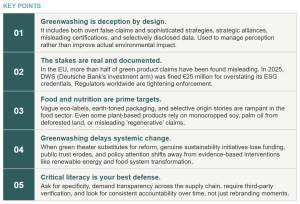
At its core, greenwashing occurs when a company’s marketing overstates its environmental benefits or obscures its harms. The term traces back to environmentalist Jay Westerveld, who coined it in 1986 to describe hotels encouraging guests to reuse towels to “save the environment”—while actively expanding beachfront development.
Decades later, researchers have identified at least three evolutionary phases of the practice:
- Greenwashing 1.0 — overt, surface-level claims: vague slogans like “all-natural” or “green” applied to products with no supporting evidence.
- Greenwashing 2.0 — sophisticated perception management: strategic use of certifications, corporate sustainability reports, and alliances to signal responsibility without substantive reform.
- Greenwashing 3.0 — narrative control: shaping future-oriented stories about “net zero” or “regenerative” commitments that are structurally impossible to verify in the present.
A company may, for example, declare “carbon neutrality” while relying entirely on unverified offset credits—a practice increasingly scrutinized by regulators. Or it may promote a “plant-based” product sourced from monocropped soy grown on land recently cleared of forest. These moves do not eliminate environmental harm; they relocate it—and hide it behind a label.
Why Greenwashing Harms More Than Reputations
The consequences of greenwashing extend far beyond misleading a single consumer. The research literature documents four compounding harms:
It Erodes Public Trust. Studies show that discovering false sustainability claims significantly reduces consumer confidence and damages brand credibility. Critically, this erosion of trust extends beyond the offending company—it can contaminate public perception of legitimate sustainability efforts sector-wide.
It Distorts Market Competition. Companies investing genuinely in sustainable practices face an uneven playing field when competitors spend more on green marketing than on actual reform. The EU found that over half of products marketed as “sustainable,” “green,” or “eco-friendly” make claims that are unclear, unsubstantiated, or outright false—a finding that rewards deception and penalizes integrity.
It Delays Systemic Reform. When polluting industries successfully brand symbolic gestures as progress, political and financial attention shifts away from structural solutions—renewable energy infrastructure, regenerative agriculture at scale, or food system transformation. The United Nations has explicitly warned that greenwashing “promotes false solutions that distract from and delay credible action” on climate.
Regulators Are Responding, But Deception Remains Widespread. In April 2025, Deutsche Bank’s investment arm DWS was fined €25 million by German prosecutors after investigators found that its self-described position as an “ESG leader” and claims that sustainability was “in its DNA” did not reflect its actual investment practices. That fine followed a $19 million settlement with the U.S. SEC in 2023 on similar charges—the largest greenwashing penalty ever imposed on an asset manager by that agency. These enforcement actions signal a shift: the era of consequence-free green branding is ending.
The Food Sector: A Particularly Fertile Ground
Food and nutrition systems offer some of the most complex, and consequential, examples of greenwashing. The food system accounts for approximately 34% of total global greenhouse gas emissions, making honest environmental communication in this sector a matter of genuine public health importance.
Common tactics in food marketing include:
- Vague eco-labels: Terms like “clean,” “natural,” “sustainable,” or “eco-friendly” appear on packaging with no independent verification or defined standards.
- Visual greenwashing: Earth tones, pastoral imagery, and illustrations of small family farms are used to create an impression of environmental stewardship that may bear no relationship to actual supply chain practices.
- Selective origin claims: Highlighting one sustainably sourced ingredient while obscuring high-impact components of the same product.
- Unverifiable “regenerative” claims: The term “regenerative agriculture” has gained significant traction but lacks regulated definitions. A 2025 report found that only one-third of global agrifood businesses claiming to use regenerative agriculture have any formal targets in place.
- Carbon offset reliance: Prominent UK food retailers have been found making climate claims, including “carbon neutral” and “net zero”—that depend on offset mechanisms lacking transparency or durability.
Even plant-based products are not immune. When industrially processed vegan foods rely on monocropped soy or palm oil from deforested regions, the environmental logic collapses. The problem is not plant-based eating—the evidence for its environmental advantages remains robust. The problem is failure to assess the full system, from soil health to supply chain integrity.
A systematic review of greenwashing in the food industry published in 2024 identified advertising opacity, lack of supply-chain transparency, and proliferating private certifications as the three leading structural contributors to deceptive environmental claims in the sector.

How to Spot (and Stop) Greenwashing
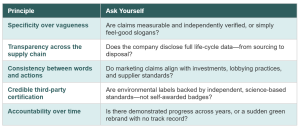
Building the capacity to evaluate environmental claims critically is a core competency for clinicians, educators, and patients alike. The following framework offers practical filters for assessing any sustainability claim—in the clinic, at the grocery store, or in policy conversations.
Technology is beginning to assist. Researchers have fine-tuned ClimateBERT—an AI language model pre-trained on two million climate-related texts—to identify greenwashing risk in corporate sustainability reports, achieving an accuracy of 86% on test data. While promising, even these tools acknowledge that greenwashing detection depends on consistent data access and agreed-upon definitions, both of which remain works in progress.
What This Means for Health Professionals and Educators
Clinicians and health educators occupy a position of unique credibility in their communities. When patients ask whether a “clean label” food is genuinely better for the planet—or whether a “carbon neutral” supplement company is worth supporting—those questions deserve evidence-based answers.
That means developing habits of inquiry:
- Ask what independent body certified the environmental claim and what standards they applied.
- Distinguish between life-cycle evidence (full supply chain) and product-level claims (a single ingredient or production step).
- Recognize that an absence of bad news is not the same as the presence of good data.
- Support regulatory and organizational frameworks—such as the EU’s 2024 Green Claims Directive—that require companies to substantiate environmental claims before publication.
Within The Plantrician Project’s mission, combating greenwashing is inseparable from advancing the Power of the Plate. A food system that genuinely supports human and planetary health must be grounded in verifiable, system-wide evidence—not in the language of sustainability deployed as a marketing tool.
Transparency is not just ethical practice. It is the foundation of trust, and trust is the foundation of lasting change.

References
1.Free C, Jones S, Tremblay MS. Greenwashing and sustainability assurance: A review and call for future research. J Account Lit. 2024. doi:10.1108/JAL-11-2023-0216
2.Nugraha WS, et al. Greenwashing in the food industry: A systematic review exploring the current situation and possible countermeasures. Clean Respons Consum. 2024;15:100227.
3.United Nations. Greenwashing in climate action. Published 2023. https://www.un.org/en/climatechange/science/climate-issues/greenwashing
4.ESG Today. Deutsche Bank’s DWS fined $27 million for greenwashing. April 2, 2025. https://www.esgtoday.com/deutsche-banks-dws-fined-27-million-for-greenwashing/
5.Changing Markets Foundation. Feeding Us Greenwash: An Analysis of Misleading Claims in the Food Sector. Published 2024. https://changingmarkets.org/report/feeding-us-greenwash-an-analysis-of-misleading-claims-in-the-food-sector/
6.Carbon Literacy Project. Addressing greenwashing in the food sector. Published 2024. https://carbonliteracy.com/addressing-greenwashing-in-the-food-sector/
7.Shankar A, Xu J. Leveraging language models to detect greenwashing. arXiv preprint. 2023; arXiv:2311.01469.
8.Anti-Greenwash Charter. Top greenwashing fines of 2025: Key lessons. Published October 2025. https://antigreenwashcharter.org/the-biggest-greenwashing-fines-of-2025-and-what-they-teach-us/
9.Global Alliance for the Future of Food. Food systems are at risk of greenwashing—here’s how to fight back. Published 2024. https://futureoffood.org/insights/food-systems-are-at-risk-of-greenwashing-heres-how-to-fight-back/
The Plantrician Project | plantricianproject.org | This article is intended for educational purposes. Always consult primary sources for clinical decisions.