Introduction
In January 2026, the American Heart Association (AHA) released updated dietary guidance that diverges in significant ways from the concurrently released 2025–2030 Dietary Guidelines for Americans (DGA), the federal government’s official nutrition policy. Both documents agree on reducing ultra-processed foods and added sugars, but they offer strikingly different recommendations on protein sources, dairy fat, and dietary fats, areas where the scientific evidence is robust and consequential for public health.
This article examines those divergences through the lens of peer-reviewed evidence, highlights where the federal guidelines deviate from the science, and provides clinicians, educators, and informed consumers with an objective framework for understanding the debate.
Side-by-Side: Key Areas of Agreement and Conflict
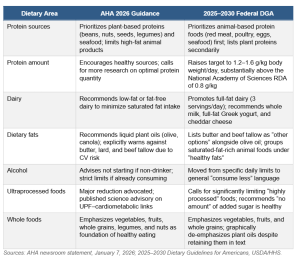
The table below summarizes the most clinically significant differences between the two sets of guidance.
1. Protein Recommendations: Animal vs. Plant Priority
What the federal guidelines say
The 2025–2030 DGA recommends consuming 1.2–1.6 g of protein per kilogram of body weight per day—a substantial upward revision from the National Academy of Sciences’ Recommended Dietary Allowance (RDA) of 0.8 g/kg. The guidelines direct consumers to prioritize “a variety of protein foods from animal sources, including eggs, poultry, seafood, and red meat,” with plant proteins listed as a secondary option.[1,2]
What the evidence shows
The 2025 Dietary Guidelines Advisory Committee (DGAC), the independent scientific body that informed the DGA development, did not recommend this elevated protein target or the animal-protein-first hierarchy. One DGAC member noted that the biggest deviation from the science was “a new prioritization of animal sources within the protein food group, instead of a plant-forward pattern.”[3]
A substantial and growing body of evidence supports plant-based proteins over red and processed meat for cardiovascular health. The DGAC’s own systematic review found that substituting processed meat and red meat with plant-based protein foods (beans, peas, lentils, nuts, and soy) is associated with a lower risk of cardiovascular disease, a conclusion graded as moderate-to-strong.[4,5]
High red meat intake has also been consistently linked to increased cancer risk, particularly colorectal cancer, across systematic reviews and meta-analyses of prospective studies.[6]
The AHA guidance aligns more closely with the comprehensive body of peer-reviewed evidence, urging consumers to “prioritize plant-based proteins, seafood and lean meats and to limit high-fat animal products including red meat, butter, lard and tallow, which are linked to increased cardiovascular risk.”[7]
Stanford University’s nutrition program noted that the federal guidelines place a strong emphasis on protein intake “despite robust evidence that shows most Americans already consume sufficient amounts,” and that the proposed targets are difficult to meet without exceeding recommended limits for saturated fat and sodium.[8]
2. Full-Fat Dairy: Where the Evidence Is Most Nuanced
What the federal guidelines say
The 2025–2030 DGA promotes full-fat dairy products, recommending 3 servings per day at a 2,000-calorie level, and include whole milk, full-fat Greek yogurt, and cheddar cheese as primary examples. FDA Commissioner Makary stated during the guideline release press conference that schools should “not push low-fat milk to kids.”[1,9]
What the evidence shows
The evidence on dairy fat is genuinely more complex than the evidence on red meat or butter, but it does not straightforwardly support the promotion of full-fat dairy over low-fat alternatives.
The American College of Cardiology’s January 2026 analysis of the new DGA noted that while cheese raises LDL cholesterol compared to unsaturated fat sources, dairy food consumption has not been consistently associated with increased cardiovascular risk, suggesting possible differences between dairy fat and butter or red meat fat. However, the same analysis warned that if consumers follow the DGA’s recommended servings of full-fat dairy, their saturated fat intake from dairy alone could reach 17 grams per day on a 2,000-calorie diet, leaving almost no room for other saturated fat sources while still remaining within the 10% calorie limit the guidelines themselves retain.[2]
One DGAC member emphasized that the full-fat dairy recommendation is “a critical deviation from science,” particularly because three daily servings raise concerns about saturated fat content, and approximately 75% of the global population is lactose intolerant, a demographic reality the guidelines inadequately address.[3,8]
The AHA’s position, recommending low-fat and fat-free dairy, remains better supported by the totality of evidence on saturated fat and LDL cholesterol, particularly for individuals with existing or elevated cardiovascular risk.
For clinicians and patients motivated to optimize health outcomes, replacing dairy calories with diverse plant-based sources of calcium, protein, and healthy fats (legumes, nuts, seeds, fortified plant milks, leafy greens) addresses nutritional needs without the saturated fat burden or the hormonal and inflammatory concerns associated with higher dairy intake.
3. Dietary Fats: Butter and Beef Tallow vs. Plant Oils
What the federal guidelines say
The 2025–2030 DGA describe “healthy fats” as those found in “meats, poultry, eggs, omega-3–rich seafood, nuts, seeds, full-fat dairy, olives, and avocados,” and list butter and beef tallow as
acceptable cooking fat “options.” Olive oil is the only plant oil mentioned, and it is framed as a secondary recommendation rather than a primary healthy fat.[1,9]
What the evidence shows
This guidance is not well supported by the evidence base and stands in direct contrast to the conclusions of the independent DGAC scientific review process.
Feeding trials and cohort studies consistently show that saturated fats, especially from butter and, to a lesser extent, beef fat, raise LDL cholesterol compared to olive oil and other plant oils. Higher butter versus liquid plant oil intake is associated with higher risk of death from all-causes and cardiovascular disease.[2,10]
A 2025 analysis published in JAMA Internal Medicine examining butter and plant-based oils intake found a significant association between butter consumption and increased mortality, while plant oil consumption was associated with decreased mortality risk.[2]
Stanford’s nutrition program explicitly noted a factual inconsistency in the DGA: “The guidelines suggest prioritizing healthy fats that provide essential fatty acids, yet the examples provided—olive oil, butter, and beef tallow—contain negligible amounts of the two types of essential fats.”[8]
The DGA’s own retained limit of less than 10% of calories from saturated fat is internally inconsistent with its promotion of butter, beef tallow, and full-fat dairy. The Harvard T.H. Chan School of Public Health analysis found that following the DGA’s recommended full-fat dairy servings alone could consume most of the daily saturated fat budget, leaving no margin for the red meat and butter also featured prominently in the guidance.[3]
Vegetable oils high in polyunsaturated and monounsaturated fatty acids (e.g., canola, soybean, sunflower) were notably absent from the DGA’s healthy fat guidance despite being primary dietary sources of the omega-6 and omega-3 essential fatty acids linoleic acid and alpha-linolenic acid.[3]
4. Where Both Guidelines Agree: Shared Science-Based Priorities
Despite significant divergences, the AHA and the 2025–2030 DGA share several core, evidence-supported recommendations that clinicians and educators can emphasize without ambiguity:
- Ultra-processed foods. Both advocate for major reductions in ultra-processed foods high in added sugars, sodium, and saturated fat.
- Added sugars. The DGA makes a historically strong statement that “no amount” of added sugar is part of a healthy diet, a position the AHA strongly endorses and has advocated for decades.
- Whole foods. Both emphasize whole vegetables, fruits, and whole grains as foundational components of healthy dietary patterns.
- Sugary drinks. Both recommend significant reductions in sugar-sweetened beverages.
- Alcohol. Both advise limiting alcohol consumption, though with differing degrees of specificity and confusing non-specific language in the DGA’s.
5. A Note on Methodology and Scientific Integrity
Beyond the specific content differences, several nutrition researchers have raised concerns about the process through which the 2025–2030 DGA were finalized.
A DGAC member who served on the independent scientific advisory committee stated: “As of today, there has not been transparency in who wrote the new DGAs. Although there are documents included in the appendices by named scientists, there is no transparency in the methodology and rigor that was employed, or why certain topics were selected to be relitigated. The reviews themselves, as well as their overall presentation and integration, deviate significantly from the rigorous process that HHS developed for the DGAs.”[3]
Reviewers’ financial ties to the beef and dairy industries were disclosed in supplemental analysis but have been flagged as a concern given the prime placement of meat and dairy products in the final guidelines.[11]
Stanford’s nutrition team also noted simple factual errors in the guidelines, including the listing of xylitol (a sugar alcohol) as a non-nutritive sweetener—errors that “call into question the adequacy of the expert review of the new guidelines.”[8]
Clinical and Public Health Implications
For healthcare professionals, the divergence between the AHA and the federal DGA creates both an opportunity and a responsibility. Patients and consumers who encounter conflicting messages from government and medical authority sources may experience confusion that undermines behavior change.
Clinicians should be aware that:
- The federal DGA’s internal inconsistency, retaining saturated fat limits while prominently featuring butter, beef tallow, and full-fat dairy, may lead to unintended increases in saturated fat intake and disease risk when followed literally.
- The protein quantity increase (1.2–1.6 g/kg) was not recommended by the independent scientific advisory committee and is difficult to achieve without exceeding saturated fat and sodium intake recommendations if animal proteins are prioritized.
- The evidence more strongly supports plant-based proteins over red and processed meats for long-term cardiovascular and cancer risk reduction.
- Low-fat or no dairy remains better supported than full-fat dairy for higher-risk populations and for the general population where approximately 75% are lactose intolerant; for the general population, evidence is more equivocal, though the practical saturated fat math of 3 full-fat dairy servings per day is concerning.
Conclusion
The 2025–2030 Dietary Guidelines for Americans represent a step forward in some areas, particularly the strong stance on ultra-processed foods and added sugars. However, the promotion of red meat and animal products as a primary protein source, the recommendation of full-fat dairy at 3 servings per day, and the inclusion of butter and beef tallow as “healthy fat” options are not well supported by the current body of evidence, and, in several cases, directly contradict the conclusions of the independent scientific committee that informed the guidelines’ development.
The AHA’s 2026 guidance more closely reflects the preponderance of evidence on cardiovascular disease prevention: prioritize plant-based proteins, use liquid plant oils for cooking, choose low-fat dairy, and limit high-fat animal products. These recommendations align with decades of prospective cohort data, randomized controlled trials, and systematic reviews.
The totality of evidence most strongly supports whole-food, plant-predominant dietary patterns as the foundation of long-term health. A 2024 umbrella review, the highest level of evidence, published in PLOS ONE synthesizing systematic reviews and meta-analyses from 2000 to 2023 found that vegetarian and plant-based diets are significantly associated with improved lipid profiles, better glycemic control, lower BMI, reduced systemic inflammation, and lower risk of ischemic heart disease and cardiovascular mortality.[12]
The American College of Cardiology’s 2026 analysis of the new federal guidelines concluded that “unprocessed, fiber- and nutrient-rich plant foods featured in vegetarian, whole-food plant-based, Mediterranean, and DASH diets are optimal for CV health, cancer reduction, and longevity.”[2] These findings are further reinforced by a 2024 review in Recent Progress in Nutrition demonstrating that plant-forward dietary patterns reduce all-cause mortality by 8–22%, cardiovascular mortality by 19–28%, and cancer mortality by 11–23% compared to typical Western dietary patterns.[13]
For clinicians seeking a single, evidence-grounded framework to share with patients, the message is consistent across decades of research and across multiple major health authorities: build the plate around diverse, minimally processed plant food.
References
[1] U.S. Department of Agriculture and U.S. Department of Health and Human Services. Dietary Guidelines for Americans, 2025–2030. Washington, DC: USDA; January 2026. Available at: https://realfood.gov/
[2] Williams KA, Dastmalchi LN, Neal D, et al. How do the 2025-2030 Dietary Guidelines for Americans measure up for cardiovascular health? American College of Cardiology: Latest in Cardiology. Published January 27, 2026. Accessed April 2, 2026.
[3] Fung T, Giovannucci E, Tobias D. Understanding the new Dietary Guidelines for Americans. Harvard T.H. Chan School of Public Health. January 13, 2026. Available at: https://hsph.harvard.edu
[4] U.S. Department of Agriculture Nutrition Evidence Systematic Review. What is the relationship between food sources of saturated fat consumed and risk of cardiovascular disease? 2025 DGAC Systematic Review. Available at: https://nesr.usda.gov
[5] U.S. Department of Agriculture Nutrition Evidence Systematic Review. Food Sources of Saturated Fat and Cardiovascular Disease. 2025-DGAC Protocol. Available at: https://www.dietaryguidelines.gov
[6] Farvid MS, Sidahmed E, Spence ND, Mante Angua K, Rosner BA, Barnett JB. Consumption of red meat and processed meat and cancer incidence: a systematic review and meta-analysis of prospective studies. Eur J Epidemiol. 2021;36(9):937-951. doi:10.1007/s10654-021-00741-9
[7] American Heart Association. New dietary guidelines underscore importance of healthy eating. AHA Newsroom. January 7, 2026. Available at: https://newsroom.heart.org
[8] Stanford University School of Medicine. What the 2025-2030 Dietary Guidelines get right—and where they fall short. January 30, 2026. Available at: https://med.stanford.edu
[9] National CACFP Association. 2025-2030 Dietary Guidelines for Americans Released. January 8, 2026. Available at: https://www.cacfp.org
[10] Zhang Y, Chadaideh KS, Li Y, et al. Butter and plant-based oils intake and mortality. JAMA Intern Med. 2025;185(5):549-560. doi:10.1001/jamainternmed.2025.0205
[11] Hu F. Dietary Guidelines for Americans 2025-2030: Progress on added sugar, protein hype, saturated fat contradictions. Harvard T.H. Chan School of Public Health, The Nutrition Source. January 9, 2026. Available at: https://nutritionsource.hsph.harvard.edu
[12] Terzo S, Calvi P, Mulè F, Amato A. Cardiovascular health and cancer risk associated with plant-based diets: an umbrella review. PLoS One. 2024;19(5):e0300711. doi:10.1371/journal.pone.0300711
[13] Mendis S. Diet and prevention of cardiovascular disease. Recent Prog Nutr. 2024;4(3):011. doi:10.21926/rpn.2403011